*Be Advised* The Following Contains Minor Dark Tower Spoilers
Are you telling me that the studios have so little respect for King's source material that they're going to make the Gunslinger . . . British!?
Personally, I couldn't care less what color Roland Deschain's skin is. Unless somebody has a TARDIS or a Delorean with which they can go back in time and snap up a young Clint Eastwood, I really couldn't think of a better actor to play the Gunslinger than Elba (with the possible exception of Javier Bardem). And yet, for some reason, thousands of people have taken to their keyboards in utter outrage over the casting choice. To which Stephen King himself had the following response:
But what does he know about The Dark Tower really, he just wrote the damn things...
The most popular complaint against Elba's casting seems to be that the Gunslinger's change in complexion irrevocably alters the dynamic between Roland Deschain and Detta Walker in the second Dark Tower book, The Drawing of the Three. Setting aside the fact that you could simply replace the words "honky mafa" with "uncle tom" and probably have the exact same scene, I think that the primary problem with this argument (and most others that decry changes to the source material) is that it is impossible to make a Dark Tower movie without changing large portions of the story.
Consider the nonlinear way in which the story is told, and the fact that 80% of one of the books is a flashback, and a flashback within a flashback. Consider the fact that King actually writes himself into the story in the latter books, and the fact that large portions of the early ones feature internal telepathic conversations between characters. Finally, consider the fact that there are a number of characters and plots that interconnect in the Dark Tower series which currently belong to other studios.
There are going to be changes to this story, there just have to be. It's too vast, to weird, and too meta to ever work in Hollywood. And that's fine. Making a different story on the big screen doesn't take anything away from the books that we all know and love. I plan on enjoying these movies for what they are, and just taking it as an alternate tale of Roland and his Ka-Tet. There are other worlds than these after all. After an Oscars ceremony so white that I thought somebody poured bleach all over it, I think that it's refreshing to see a person of color receiving such a prominent role in a beloved franchise. Idris Elba is a tremendous actor, and I look forward to his interpretation of the character.
And as excited as I am for Elba, I am twice as pumped for Matthew McConaughey as Randall Flagg. If you asked me this in 2013, I would never have thought that the Lincoln Lawyer guy could pull of the Dark Man, but over the past few years McConaughey has blown us all away with his roles in movies like Interstellar and The Dallas Buyers Club, and of course his mind blowing performance as Rust Cohle in HBO's True Detective.
What makes doubly excited is that McConaughey will be playing Flagg in the movie adaptations not only of The Dark Tower, but also The Stand. You know what that means? Expanded universe baby! McConaughey has the intensity to bring Flagg to life, and even redeem the character from his mediocre exit in the seventh Dark Tower book.
Shake the hand that shook the world. Alright, alright, alright.
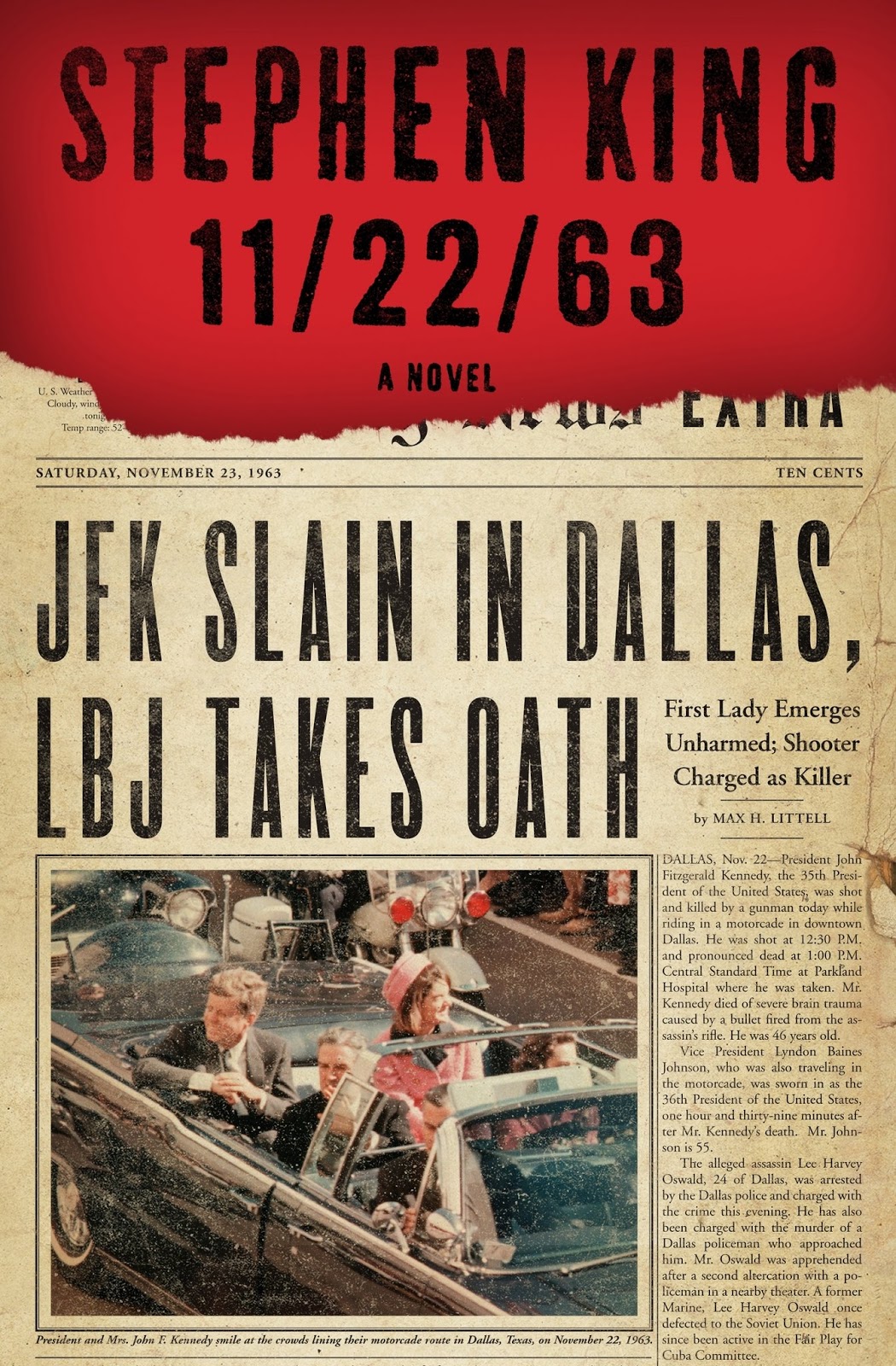
This is a series that I have been looking forward to for quite some time. As many of us constant Stephen King readers by now know, movie or television adaptations of his work tend to be hit or miss. Sometimes you get a Misery or a Shawshank Redemption, and other times you get Children of the Corn 666: Isaac's Return. When this project was first announced, I was beyond thrilled. In addition to being a personal favorite of mine, 11/22/63 is really one of King's overall best novels, and by far the best one he's written in recent years.
Left to right: James Franco, Stephen King, and J.J. Abrams
As more news came about this project, the more optimistic I became. Hulu brought an all-star cast and crew to the table, with J.J. Abrams directing, and the inspired choice of James Franco for the story's lead, Jake Epping. I also believe that a miniseries works much better for adapting a long novel like this than a movie, and a story like 11/22/63 doesn't need some eight figure Hollywood Budget budget to pull off. And of course Netflix and Amazon have certainly set the bar high for original programs produced by digital streaming services.
Last night, after a long wait and many high expectations, the first episode has finally aired. Amazon and Netflix typically drop a full season of one of their shows all at once, embracing the habit that their viewers typically have of binge-watching shows over a single week. Hulu does things differently, releasing a single episode per week, more like traditional networks, so rather than offering up a review of the whole series, as I had hoped, I'll be dropping my early thoughts and impressions here, and updating them as the series progresses.
As to that, after viewing the first episode, The Rabbit Hole, my feelings are . . . mixed.
The talent assembled for this project is nothing short of staggering, and the directing, acting, and cinematography are everything I would expect from an all-star cast such as this. In particular the shifts in tone, from the sunny optimism in "the land of Ago," to the slow and menacing presence of Little Eddie the bookie, provided an immersive atmosphere worthy of King's original novel.
Unfortunately for all the points that The Rabbit Hole gains for acting and atmosphere, it loses for pacing and storytelling. The first episode felt extremely rushed, and it seemed like a lot of King's original material was being pushed aside to make room for hokey or nonsensical subplots born in the writer's room.
Now bear in mind, there are always going to be some changes when adapting a story across different mediums. There are some storytelling techniques that are used in books that aren't available in movies or television, and vice versa. With TV shows in particular, which boast significantly smaller budgets than movies, there are sometimes plot elements that have to be changed for monetary reasons. The best adaptations are almost always those which stay truest to the books (Blade Runner notwithstanding), but a writer or directer that treats the source material as unimpeachable or sacred will quickly see their project fall apart over practicality issues alone.
The problem comes, however, with the fact that television writers often have less intellectual respect for their audiences compared to novelists. We're living in what many are calling the Golden Age of television, and with the explosive popularity of HBO's Game of Thrones, we are also seeing a lot of novels (and comic books) being adopted for TV. Unfortunately, there seems to be a trend lately of dumbing down material, either because writers think that the average television viewer won't be able to understand a complex story, or to convey a sense of false drama because we're just too dim to be invested in the story based on its own merit. The latter, I think, is the crux of The Rabbit Hole's pacing issues.
There's very little action during the first fourth or so of King's novel. Much of the plot is dedicated to Jake's planning with Al, trial and error with the time portal, and his exploration of and acclimation to the land of Ago. King's vision of 1958, seen through Jake Epping's contemporary eyes, is rivaled only by his descriptions of rural New England in stories like 'Salem's Lot and One for the Road. Without idolatry or adulation, King gives us an endearing yet honest vision of a simpler time, warts and all. We get the clean air and root beer right along with segregation and the Cold War. Jake's conflicting feelings about this time is really what puts us behind the proverbial wheel, and King accomplishes this very well.
The show, by contrast, skips over most of this is in a brief montage and some expositional narration on Al's behalf. Had the plot been pressed for time, this might be understandable (though I find this hard to accept in an eight-episode miniseries), but it seems that most of the time made up skipping over the source material is dedicated to subplots that are artificially inserted into the narrative in a lazy attempt to get people's hearts racing.
Did anybody really buy, for example, that Jake would bring a knife back in time with him that had the name and dates of the Vietnam war on it? Or, can you think of a more cliche way of escaping a violent bookie than by distracting him with a video on a smartphone (which somehow was able to stream in 1960)? I won't even get into the Benny Hill chase scene where a schoolteacher from Maine almost escapes the Secret Service, or what Jake hoped to accomplish by calling his father up on the phone, and even going so far as to call him "Dad."
I can't help but think that these scenes were inserted only because the studio felt that audiences would tune out if they were bombarded by too much political backstory, or travel scenes, or nuances of the less sexy parts of Jake's quest. If there's one lesson that we can take, however, from a show like AMC's Breaking Bad, it's that audiences are willing to A) use their brains while watching television, and B) wait for the pig payoff.
Overall I have to say I was somewhat underwhelmed by the first episode of 11/22/63. Part of this, I suspect, is due to the high expectations I had going in. As far as your typical Stephen King adaptation goes it's okay. Not the worst, but certainly not up to par with the best either. It was better than Under the Dome, that's for damn sure, but it also had a much better story to draw upon, and (with the exception of Dean Norris) a better cast and crew to bring the material to life. Whether or not 11/22/63 lives up to its own promise remains to be seen. I'm still optimistic, but my enthusiasm has dulled somewhat after the first episode.
*WARNING* This post may contain spoilers for the following novels by Stephen King: Carrie, The Shining, The Stand, Doctor Sleep, The Dark Tower series.
One of the most fun aspects to Stephen King's work is the way in which so many of his stories intersect with each other. Some of them are overt call backs or crossovers like the towns of Derry and Castle Rock, or the many Dark Tower connections. Others are more subtle, and are left to the reader to pick up on, such as Jake Epping's discovery of KA in 11/22/63. During a recent reread of some of King's early work, I think that I've found one such connection spanning primarily between the novels Carrie, The Shining, and The Stand, and even into King's recent novel, Doctor Sleep.
In the broadest strokes, it goes like this: Carrie White had the Shining, the same ability that Danny Torrance has in the novel of the same name. Carrie's mother, Margaret White, may have had the same ability, or she may have been receiving actual visions from Gan regarding the apocalyptic events of The Stand, or something similar. This is based on the following textual evidence:
Parallels between Carrie White and Abra Stone.
Parallels between Margaret White and Mother Abigail.
Visions from Margaret White that seem to be about Randall Flagg.
Carrie and the Shining:
Though often unexplained, I believe that the Shining is actually one of the oldest and most commonly occurring hallmarks in King's fiction, right up there with The Dark Tower and the state of Maine. You see it in almost all of his books. Characters with unexplained powers, or who just seem to know things, like when they're in danger or which door has a trap on the other side. One of the first things that Dick Hallorann tells little Danny Torrance at the beginning of The Shining is that a lot of people Shine to some degree or another.
Carrie was King's first novel, and its titular character is either gifted or cursed (depending on your perspective) with psychic powers that take her down a disastrous and bloody path. Carrie's powers are studied throughout the story, but never explained. For years I never connected Carrie's abilities, which were telekinetic, with Danny Torrance's Shine, which was predominantly telepathic in nature. I hadn't made the connection, that is, until last year when I read Doctor Sleep, King's sequel to The Shining.
In Doctor Sleep we meet a girl named Abra Stone. Abra, like Danny before her, has the Shining, but if Danny Shines like a candle then Abra would be more akin to a bonfire . . . or a lighthouse. Her gift is powerful, and in addition to the precognitive and telepathic abilities that Danny had, she also displays an aptitude for making things move. It's in reading about Abra that we see a number of similarities with Carrie.
Abra had exceptionally strong telekinetic abilities when she was a small child, but they faded as she grew older. Toward the end of the novel, when she's a teenager, they come back to her and grow even stronger than they were before. The way Abra's powers wax and wane directly parallels the narrative in Carrie. We know that Carrie had powerful telekinetic abilities as a small child, slamming all of the windows in the house at once without realizing what she was doing, or calling down a rain of stones onto her house when she was scared. These powers completely fade away until the opening of the novel, when Carrie, also a teenager, unconsciously uses them after she gets her first period. From this point on, just like Abra, Carrie finds her abilities becoming more and more powerful, leading ultimately to the bloody climax of the story where she uses them to massacre everyone at her prom.
There were also situations where Carrie was upset or angry and unconsciously used her powers to break things. At one point she smashes some of her mother's kitchenware. Abra too, in Doctor Sleep, accidentally uses her powers to smash a number of antique dishes during a fight with her parents.
Margaret White, Mother Abigail, and Randall Flagg:
Carrie's mother, and by extension her upbringing, is by far the biggest distinguishing factor that separates her path from that of Abra, who ultimately uses her powers for good. Margaret White, evil, fanatical, and three kinds of crazy, is about as far from the kind and benevolent Mother Abigail that we meet in The Stand as one might imagine. There are similarities between the two however, the most notable of which being the religious visions that each of them claims to have. Both women claim to hear messages from God warning them, to various degrees, of an impending apocalyptic event. Most specifically, it seems that they are both having visions of Randall Flagg.
"There's a storm coming. His storm!"
Often times throughout the novel, Carrie and her mother recall visions of a "Black Man," described as a corrupting, Satanic figure bent on some kind of apocalyptic destruction. This is Flagg's modus operandi through and through. He travels from world to world, corrupting and destroying, felling kingdoms and governments like bowling pins. Even the name, "The Black Man," is synonymous with Flagg's titles "The Dark Man," and "The Man in Black."
There are three explanations that I can think of as to why Margaret White would be having visions of Randall Flagg. Either Gan (the God of Stephen King's multiverse) was sending the visions as a warning, as Mother Abigail claimed to have experienced, or Flagg himself sent the visions to drive her insane and by extension remove Carrie as a possible threat to his future plans.
Assuming that neither of these are the case, I think it's also likely that, if Carrie had the Shining, Margaret shared her daughter's gift. From the books that directly deal with it, we know that the Shining is passed down through families. Jack Torrance had it, which was why he was so vulnerable to the ghosts of the Overlook Hotel. Danny had an even greater gift for it than his father, and his niece Abra has the most powerful aptitude of them all. Dick Hallorann also reveals to Danny that other members of his own family had the Shining as well, in particular his grandmother who taught him how to use his abilities.
If Margaret did have the Shining, then the visions that she experienced may not have been religious in nature at all. Rather, they were premonitions of future events which she confused as a message from God due to her own extreme dogmatic beliefs. As seen in Doctor Sleep, people with a powerful shine can foresee large-scale disasters, such as early in the book when an infant Abra had a premonition of the 9/11 terror attacks. If disasters that result in thousands dead can cause people psychic pain or distress, then an apocalyptic event like the Captain Tripps virus which killed 99% of the world's population, or the coming of Randall Flagg, could easily have such a powerful impact as to drive a person insane. With her religious upbringing, a young Maggie White probably attributed her shine to a sign from God, and the intensity of it may have been what contributed to her madness.
The author of over 60 books and almost 200 short stories, Stephen King has proven time and again since the early 70s that no novelist scares the crap out of us quite like him. And for almost as long as he's been writing them down, producers and directors have been eagerly snapping up the rights to convert his stories to the big screen. According to IMDB King has been credited with more than 200 adaptations of his stories to film or television. Some are masterpieces with multiple Academy Award Nominations, others are B movie flops that lurk in the dark, rarely traveled corners of Netflix. But all of them have had that distinct flavor that King brings to each and every one of his stories that truly makes him America's most beloved boogeyman.
With the upcoming miniseries on Hulu, 11/22/63, based on one of my all-time favorite King novels of the same name, I've decided to compile the list of what I've found to be the ten very best film adaptation's of King's work.
Full disclosure before we begin, I don't live and die by the Tomatometer. This is a purely subjective and highly biased list, and my views do not necessarily line up with those of the critics.
#10 - The Mist
Out of all King's stories, in both print and film, The Mist reveals the most influence of one of H.P. Lovecraft, one of the few writers that has contributed more to the horror genre than King. The movie predominately follows a group of locals from a small New England town that find themselves trapped in a grocery store as an alien mist rolls in and brings with it a horde of strange and violent creatures. In true Lovecraftian fashion, The Mist conveys a feeling of madness in the face of near inconceivable horror, and the utter insignificance of human life in the face of larger and more terrifying worlds.
Now, the film snob in me feels the need to disclose a preface about The Mist. It is not a good movie. At least not in the technical sense. The acting--with the exception of Marcia Gay Harden--is bad, the dialogue is worse, and the overall effect makes for some fairly cringeworthy performances. But the atmosphere! With the possible exception of Pet Sematary, have I seen a movie that so accurately captures the chill that steals up your spine when you're reading a really great Stephen King novel alone in the middle of the night. The mist is as ominous and creepy on screen as it was in King's original novel. The monsters are absolutely horrifying and the film is utterly merciless to its characters. And while I plant my feet firmly in the camp of practical effects, for the budget that it had The Mist did a decent job of bringing its menagerie of computer generated horrors to life. Then of course there's the ending...
The film's ending is even more soul-crushing than King's, and this is a novella that implicitly went the apocalyptic route. I defy you to come out of this movie feeling anything but a horrific bleakness down to your very bones.
Sharp-eyed Dark Tower fans are also in for a treat during the film's opening, where you can see Thomas Jane's character painting a portrait of Roland Deschain. This in particular was a nice touch, showing a high degree of respect and awareness of the source material. Though it's never overtly explained in the novella, those of us familiar with the Dark Tower series know that the Mist creatures actually came not from another world, as the film and novella both imply, but from Todash, the space that exists between the worlds and a concept explored during the Dark Tower books.
#9 - Cujo
The revenge of every dog that's ever been locked in a hot car, Cujo is the first movie where you'll actually find yourself rooting for the family pooch to bite a bullet. Supposedly inspired by an actual encounter that King had with a St. Bernard, Cujo follows the story of a family dog that, after contracting rabies from a bat, goes rabid and starts killing anyone that pisses it off. The movie has what I find to be a rather ironic flavor when a woman and boy find themselves trapped inside of a hot car like caged animals, while Cujo himself prowls outside trying to get at them.
A product of the 80s, Cujo recalls the influence of the slasher-pulp phenomenon wherein sexual promiscuity is both condemned and sensationalized, where adultery inevitably leads to bloody and precarious situations. The film doesn't have quite have the arrhythmia-inducing fear of Pet Sematary or The Shining, but it does squeeze a remarkable amount of story from a comparatively simple scenario. This is something that's always impressed me about both the film and the book. Overall I give Cujo a bump over The Mist because it manages to do more with less, having been filmed in the days before CGI became the go to tool for lazy directors.
8 - IT
Ah IT, the movie that single-handedly closed more clown colleges than the Great Recession. Now, technically this is a two episode miniseries, not a movie, and it never got a theatrical release. However, it was shot as a movie, and that's how it's sold and packaged today . . . and more importantly, no top ten Stephen King list of any kind can be called complete without a contribution from IT.
IT takes us to the often referenced fictional town of Derry, Maine, where a group of six outcasts come together--first as children, and then years later as adults--to confront an ancient terror dwelling in the sewers beneath their town and feeding on children. They eventually come face to face with Pennywise, the shape-shifting clown that has as long and bloody a history as Derry itself.
IT is one of the polarized movies that has as much going for it as it has factors against it. Though the film fails to capture the wistful longing for childhood and days gone by that made King's novel so brilliant, the horror elements are still very strong. That being said, unlike The Mist, IT dials back some of the more brutal parts in the novel (and thankfully does not include THAT scene from the novel . . . you know the one). But what really saves IT as a horror movie for many fans is the brilliant performance of the legendary Tim Curry as Pennywise the Clown, as well as a very creepy musical score by Richard Bellis. Nightmare fuel at its finest...
7 - The Running Man
With the explosive popularity of the dystopian future genre in recent years, I'm always surprised at just how few people are aware of this movie. We know all the tropes now; the apocalyptic society, the corrupt the government, the gladiatorial games, etc. Well, before The Hunger Games and Divergent, even before Battle Royale.
Really more of an Arnold Schwarzenegger movie than what we think of as a Stephen King flick, this isn't what you'd expect after watching the other films on this list. King himself even called it terrible, but I think that it's misunderstood. The Running Man is actually much deeper than you'd suspect for an 80s action movie. It has a quasi-Marxist kind of feel, with a lot of anti-capitalist undertones that reveal the evils that can result from the corporatization of art in the blockbuster and the exploitative privatization of the prison industry.
If you like the over the top action, Arnie one-liners, and skin tight leotards that made the 80s awesome, then this might just be the movie for you. Still not convinced? Well, what if Arnold were to say, pleeeeeeease...
6 - Pet Sematary
Seeing this movie is the reason why I shriek at cats as a grown man. Stephen King has written about child murder, necrophilia, and self-cannibalism, but in over forty years of traumatizing fans all over the world, there was only one book that he thought was too disturbing for publication. That book was Pet Sematary, and while the movie isn't quite as creepy and horrific as the novel, it is still one of the most terrifyingly disturbing films of its decade.
Pet Sematary is King's contemporary answer to W.W. Jacobs's The Monkey's Paw. If I were to sum up the story in six words, they are "be careful what you wish for." I won't write too much about the plot, because to describe the premise somewhat spoils the movie here, but in the broadest terms it examines overall the themes of life and death, and how we deal with the inevitability of either dying or living long enough to lose the ones we love. I'll admit a personal bias here, this was one of the first horror movies I've ever seen, and to this day it remains one of my personal favorites in the genre. Pet Sematary may be old, but it's as terrifying now as it was the day it his theaters back in 1989.
Pet Sematary is so awesome, even The Ramones paid tribute to it:
5 - The Shining
Directed by the late, great Stanley Kubrick, The Shining is far and away the most iconic movie on this list. It is also the movie that King himself has most vocally disavowed out of all the adaptations of his work (a list which includes eight Children of the Corn sequels). With respect to Mr. King, I don't think any can deny that The Shining is a fantastic movie, and a masterstroke by one of the greatest filmmakers in the history of American cinema.
The Shining follows the story of the Torrance family; mother Wendy and son Danny, as they follow father Jack, a frustrated playwright acting as caretaker for the Overlook Hotel during a stormy Colorado winter. As the winter snows rise and seal the Torrance family in, Jack faces demons both internal and external in what has become the quintessential standard that all haunted house strive for.
I confess that I had some difficulty in placing in this one. While The Shining, like most Kubrick films, is very visually poetic and exhibits one of the all time greatest performances by Jack Nicholson; it guts a lot of the spirit of what makes King's original novel so great. The book recalls to me a quote by William Faulkner: "The only thing worth writing about is the human heart in conflict with itself." Though there is the overlying external threat of the Overlook Hotel, the real meat of King's book is the internal struggles of the Torrance family. Jack's struggle with alcoholism, Wendy trying to hold her family together while shielding her son from his abusive father, and Danny's attempts to reconcile the father that he loves with his premonitions of the coming danger. Kubrick's film loses most of this. In the movie Jack is crazy and intimidating from the beginning, Wendy does nothing but scream, etc. King describes the book and movie as hot and cold respectively, matching up rather poetically with the ultimate fate of the Overlook. In technical terms The Shining is a better movie than the next listing, but as a Stephen King movie it falls short of...
4 - Misery
My personal favorite of this list, Misery was created from one of Stephen King's literal nightmares. According to King himself he thought of this story after he had a dream on a plane of being held captive by a woman who called herself "his number one fan." When he landed and checked into the hotel he stayed up and wrote the first three chapters at the desk that belonged to Rudyard Kipling. According to a hotel employee it was the very desk that Kipling died at, so you just know there's all kinds of spooky mojo working with this one.
Misery follows the story of Paul Sheldon, a writer who is saved from a car wreck by a deranged fan that winds up holding him hostage so she can force him to write the next installment of her favorite book series. If you've thought about doing this to George R.R. Martin then don't worry, you're not alone. If you've seriously considered it then you should seek immediate therapy.
Directed by Rob Reiner with fantastic performances by Kathy bates and James Caan, Misery is one of those movies that manages to get just about everything right. Really, I have nothing bad to say about the movie. Creepy and funny in all the right places, it's a film that does everything it sets out to and then some.
3 - Stand by Me
Also directed by Rob Reiner, Stand by Me is the most iconic coming of age movie you'll ever see. The inspiration for both The Sandlot and The Goonies, Stand by Me has all the heart of either of those movies, but with the kind of issues about life and death and growing up that makes it real in a way that adults of every generation can connect with. It will make you smile, it will make you laugh, and it will make you cry, both for the friendships of the four protagonists, and for your own lost childhood.
Following the story of four children from a small Maine town that go on a quest to find a dead body, Stand by Me is about friendship and the enduring power that our childhood bonds hold over us for years into our adult lives. Originally titled The Body, this novella was what made King's reputation for writing children years before IT was published. This movie is a classic that transcends time and will remain a classic for generations.
2 - The Shawshank Redemption
What can I say about this masterpiece that hasn't already been said? The Shawshank Redemption is, without illusions of idolatry, a perfect movie. Proof positive that King can write uplifting stories as well as he does horror, The Shawshank Redemption was robbed of the Academy Award for Best Picture by what can only be described as a freak twist of fate, having hit theaters the same year as Forrest Gump and Pulp Fiction. Chronicling the twenty year story of a man wrongly convicted of murder, The Shawshank Redemption is nothing less than the ultimate triumph of the human spirit in the face of overwhelming despair. Andy Dufresne summed up the message of this movie clearly enough, "get busy living, or get busy dying."
Narrated by the legendary Morgan Freeman, The Shawshank Redemption also tells the story of the enduring power of friendship and the light that it can provide in even the darkest of circumstances. The bond that Andy and Red share is as beautiful as anything you'll see between two characters. I defy anyone reading this to watch The Shawshank Redemption and not feel elated by the final shot of the film. I'll say it again, the acting, the musical score, the cinematography, everything about this movie is perfect.
1 - The Green Mile
I anticipate getting some flak for my choice here. Nine out of ten people will argue that between The Green Mile and The Shawshank Redemption, Shawshank is the better film. And if I were making a list of the top the top ten prison movies of all time, then Shawshank would certainly be miles ahead of The Green Mile. In speaking of Stephen King movies, however, not just those based on his works but those which most exemplify the overarching tones that King has developed over his four decades as a published author, The Green Mile is the only movie I could imagine taking the top spot.
The Green Mile tells the story of John Coffey, a black man wrongly convicted of murder in the Jim Crow South, as seen through the eyes of the Paul Edgecombe, the supervisor of the death row prison where Coffey is being held pending execution. The story also has a supernatural element, as Edgecombe discovers that his new gold-hearted inmate has the power to heal people with his hands. Coffey's story is very much that of another popular figure with the initials JC; that of a man taking the pain of the world unto himself, and suffering for the sins of others
The Green Mile exhibits all of the greatest qualities that we have come to expect from Stephen King. It's horrific and heartbreaking, and somber right to its soul. The ending in particular is what solidifies this movie in my heart forever as one of the most emotionally evocative movies around. Without spoiling anything, it reminds me somewhat of the ending to The Dark Tower. A feeling of wearisome resignation as a good man pays a high price for his sins. But not without a bit of hope that he might one day rest. That bit of hope is important. It recalls the final line of King's favorite Robert Frost poem: "And miles to go before I sleep, and miles to go before I sleep."